Restarting the Magic
Hello again! Since my last blog post I’ve been very busy with moving to Minnesota and work, but I’ve finally got into the groove of working on some projects again and I’ve got some stuff to talk about, so lets just get right into it!
So one of my projects that I’ve written about in the past is a Factorio mod known as Arcana. I’ve admittedly had a few false starts with this mod (including a recent one we’ll talk about today), but all of those have taught me things about Factorio and the game design of overhaul mods. My most recent post about this mod talked about a general overview for the mod progression as I had planned it out in Obsidian. This was all fine on paper, but when I tried to go ahead and start implementing it recently, I noticed I had some nebulous issues with what I was making, so I put down Visual Studio Code and picked back up Obsidian to analyze my thoughts. For the most part, this post is going to be a summary and rewrite of the document I wrote for myself to help organize my thoughts on the matter.
The question I posed to myself is:
What makes an overhaul mod fun and compelling?
Quite the big question, I know, but it can be broken down into a couple elements that make up a full answer.
We’re going to be analyzing the general progression of 3 popular overhauls in this section:
Space Age, the official expansion for Factorio and, yes, is technically an overhaul mod
Krastorio, which is often referred to as “baby’s first overhaul”, since it’s a relatively tame overhaul while still changing up the game enough to make it feel novel
Space Exploration, one of the larger overhaul mods, creating whole new systems for the game and being one of the major inspirations for the official expansion (in no small part because the author of this mod worked on Space Age)
In Space Age, the game is largely the same for the beginning, which the main distinct change being that the rocket silo has been moved earlier in the technology progression, specifically into chemical science (the 3rd science you make). Once you reach this point, you start to learn about the new logistics system in the expansion, space platforms, by first making a platform that can produce space science. That space science can then be used to start researching new planets to visit. Each of these planets is a designed space, with its own unique properties, resources, recipe chains, and hazards to deal with. Each of these planets culminates in a new science pack as well as a unique, highly productive building to unlock. Additionally, some existing technologies in the vanilla game have been shifted to these new planets to really incentivize the player to get to them. It might be obvious, but Space Age also changes the goal of the game, since launching a rocket is critical to the progression now. That new goal is to reach the edge of the solar system with a space platform. This is made difficult by the fact that solar power is extremely inefficient out there and asteroid density is much higher, meaning that you’ll need to build a well thought out space platform to make it. Notably, Space Age very rarely changes the recipes of base game, mostly reserving these changes for the items whose technologies have been shifted to other planets.
In Krastorio, everything feels very familiar for the vast majority of the game, but is more complex most steps of the way. The most immediately obvious change is that the vanilla science packs have been replaced with “tech cards”. Most of the vanilla science packs have a tech card analogue which has replaced it mostly 1 to 1, but there is an additional “basic tech card” that covers some of the very early technologies before becoming obsolete after a certain point, as well as a handful of late game tech cards. One thing I find very interesting about these tech cards is that, outside of needing blank tech cards, the first couple tech cards are the same “recipe”, but modifications to the recipes of the components mask a little bit of the increased complexity. As you approach the mid-game, Krastorio introduces a couple of new resources, one of which is used to make some subsequent recipes more complex, and the other of which is used for late game materials. In chemical science, there’s also an expanded chemistry aspect to the progression, such as using electrolysis to create hydrogen and oxygen from water or collecting nitrogen from the air. Finally, Krastorio also introduces a new win condition in the Intergalactic Transceiver, which demands you provide it with a fairly large amount of energy for a sustained amount of time in order to complete the game.
In Space Exploration, we have an extended “burner” phase (a phase of the game where your machines largely use fuels instead of electricity to function) followed by a relatively normal early game, notably making most base game entities require their previous tier to craft (for example, needing burner inserters to craft regular inserters to craft fast inserters. It does the same thing that Space Age does where it moves the rocket silo earlier in the tech tree, but it also slowly ramps up the production chain complexity, adding quite a few new intermediates to deal with. Launching the rocket (with a satellite, requiring 7 items to produce) produces “satellite telemetry” which is used to make a new “rocket science pack”, which is then used to start researching cargo rockets and other technologies that open up the true scale of the mod (in my current playthrough, I’m about 20 hours in and I’ve just reached this point). From this point, further base game rocket launches discover new locations in space with their own resources, hazards, etc. The first place the player will visit after building a cargo rocket and preparing their equipment to let them survive in the vacuum of space is orbit of Nauvis, the starting planet. Here, the player finds a heap of ruins with several buildings, materials, and useful items among them, and create the space science pack. This space science pack has to be manufactured in space and can only be used by a new, more advance laboratory that also can only be placed in space. This means in order to continue research, the player now needs to set up logistics for launching cargo rockets full of science packs into space, as well as the resource production to support building those cargo rockets.
Once that’s handled, the game starts being about what its name suggests: space exploration. New planets the player discovers can have varying levels of different materials like iron or copper that the player could make use of to augment their existing factory, but also can have new unique materials not found on Nauvis. Two of these materials are required components to craft production and utility science packs, which have been moved in the progression to be after space science, meaning that not only do you have to produce them in space, but you have to get all the way to this point without the logistic system technology. The science packs from this point on are quite a lot more complex than the vanilla game, with the progression splitting into 4 fields: astronomic, energy, material, and biological. Additionally, each of these science packs has 4 tiers that become more complex and use the previous tier in its recipe. Once through this part, there is a final “deep space science pack”, also with 4 tiers, that serves as the end game science pack. Even the lowest tier of this involves using all the previous 4’s materials, making it very complicated to produce. Finally, the mod also introduces a new win condition of building a spaceship capable of moving at a certain speed for a sustained period. Additionally, Space Exploration also has a secret win condition that involves searching for ancient ruins on planets to gather information to solve a complicated puzzle that unlocks a stargate.
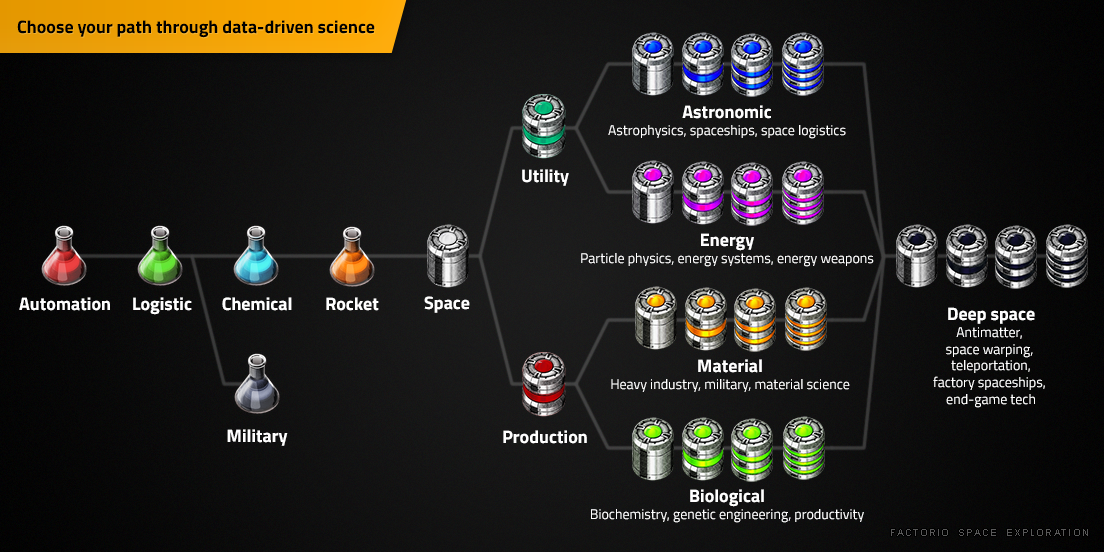
An infographic of the science pack progression from Space Exploration, taken from its mod portal page (linked)
Increased Difficulty
I tried not to talk too much about it in the previous section, but it should be pretty clear that almost universally, the point of overhaul mods is to make the game harder. Almost all overhauls modify recipes for existing items and make them more complicated, either by adding new intermediates, changing how you acquire basic resources, forcing you to scale up your factory, or some other means. This allows there to be some familiarity in some of the things you’re handling, such as your machines or basic intermediates, while also creating new challenges incrementally instead of all in one new production chain the mod adds. This, in turn, can make the modded game last significantly longer than a vanilla game. The Krastorio run I just completed recently took me about 100 hours to complete, while Space Exploration is generally expected to take somewhere between 200 and 300 hours. Compared to most people generally beating the vanilla game in somewhere between 20-40 hours their first time, it’s quite the significant increase in play time.
New Challenges
As I mess around with modding Factorio, the vanilla game feels more and more like a tech demo for the engine it runs on. There are so many features in the engine that are only used for one or two things in the vanilla game or aren’t utilized at all that many mods take and use extensively for new challenges. For example, many mods make recipes with multiple products or random outputs, production chains with loops, resources that require higher tier miners or specific fluids to mine, all of which are features built into the engine that vanilla Factorio uses very sparingly. This means that for modders, adding these features is extremely easy and allows their mod to quickly become more complex than the vanilla game with not much effort. I’m particularly fond of production chains that involve loops, especially when those loops are not stable, either generating too little or too much of the looped product, meaning the chain either needs to provide supplementary product to refill the loss or deal with excess so the output doesn’t back up.
So what do we take from this?
The summary of my quick and dirty analysis of these few mods is that the general goal of an overhaul is to increase the expected playtime from start to finish, increase recipe complexity, and potentially introduce whole new mechanics in extreme cases. Notably, many overhauls don’t remove the standard suite of buildings and intermediates, instead opting to adjust recipes and stats of those items.
This does pose the interesting question of how do we incorporate these things in our mod. There’s 2 ways to go about this, both of which are used together generally. The first is just keeping the vanilla technologies and adjusting them a bit to fit. This has the benefit of making it easier to create compatibility with other mods, since they’d be altering the same technology prototype. The other option is to make a new technology that unlocks a subset of vanilla features, but at a certain point, many modifications to a vanilla recipe can end up being more effort than just making a new one. This makes more sense in cases where you wanna adjust the order in which certain items are unlocked or want to split up the results of one technology into multiple. Like I said, both have benefits and drawbacks, and so far I’ve done both in my mod at various points. In my planning document, I’ve been designing a mock up of the technology tree to help myself see an overview not only of what I think the progression should generally look like, but also to be an at-a-glance look at the current state of implementation and any modifications I’ve made to technologies.
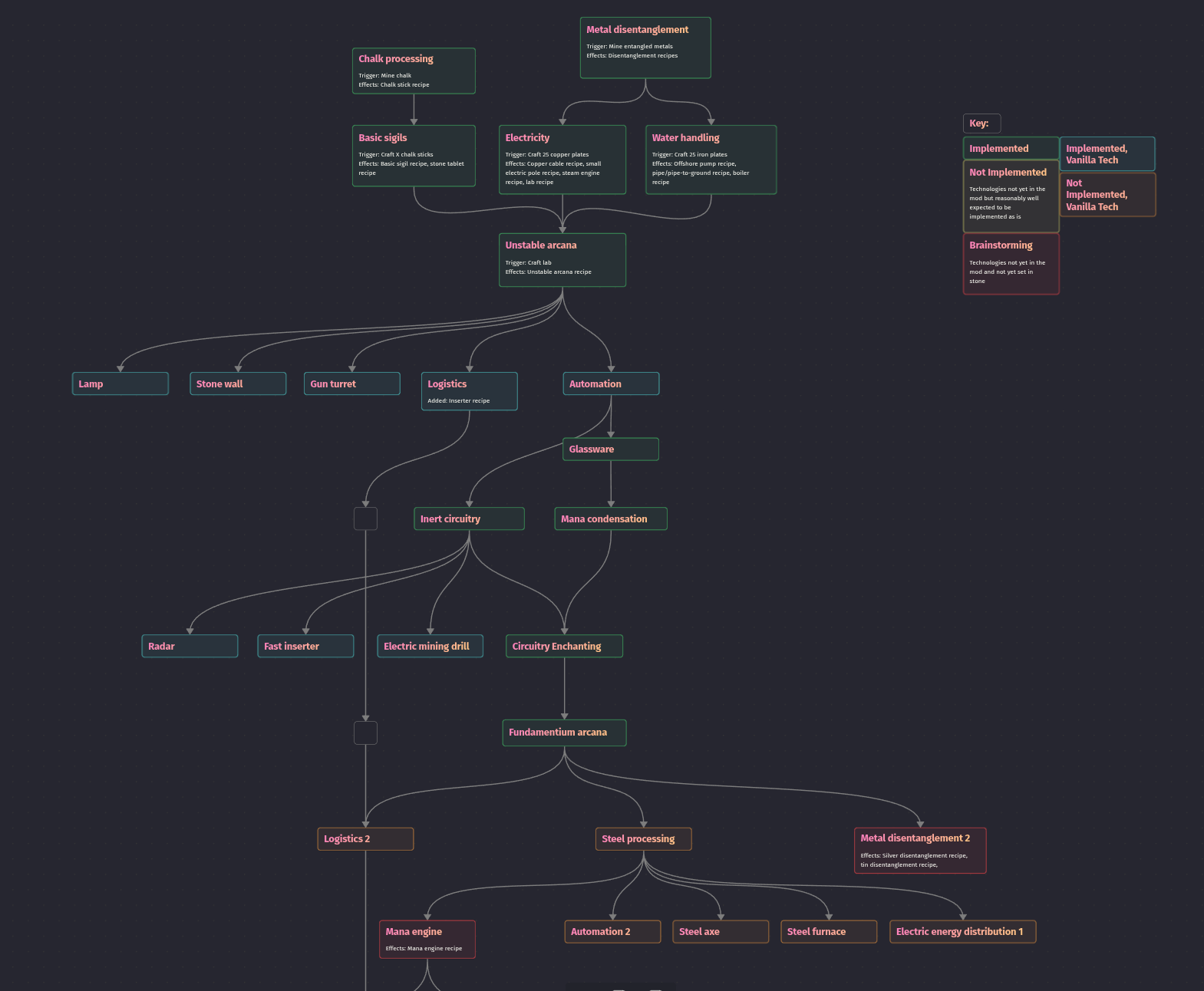
A partial screenshot of the current state of my technology tree outline document, as of 10/20/2026
As you can see, the elements are color coded, to make it easy to differentiate implementation states of each technology. Red boxes are for brainstorming; essentially things I haven’t totally locked down yet and I’m using as filler to get a better idea of what the tree could look like. The next tier are yellow and orange. Yellow technologies are new technologies from my mod that I’ve mostly decided are worth implementing, while orange technologies are vanilla technologies that I’d like to implement as is (mostly). Any adjustment to a vanilla technology is written as a note in the box (see: the logistics technology). Finally, green and blue technologies are fully implemented in the mod, green being new technologies, blue being vanilla ones. Additionally, all my new technologies contain notes of what they unlock to make it easy to check without having to boot up the game. This has proven really useful to me, not only for planning, but for reminding myself where I’m at when I return to work on the project.
Last time I wrote about the mod, I also talked about my overall plan for the mod. After doing my analysis of other mods, that has definitely shifted a bit.
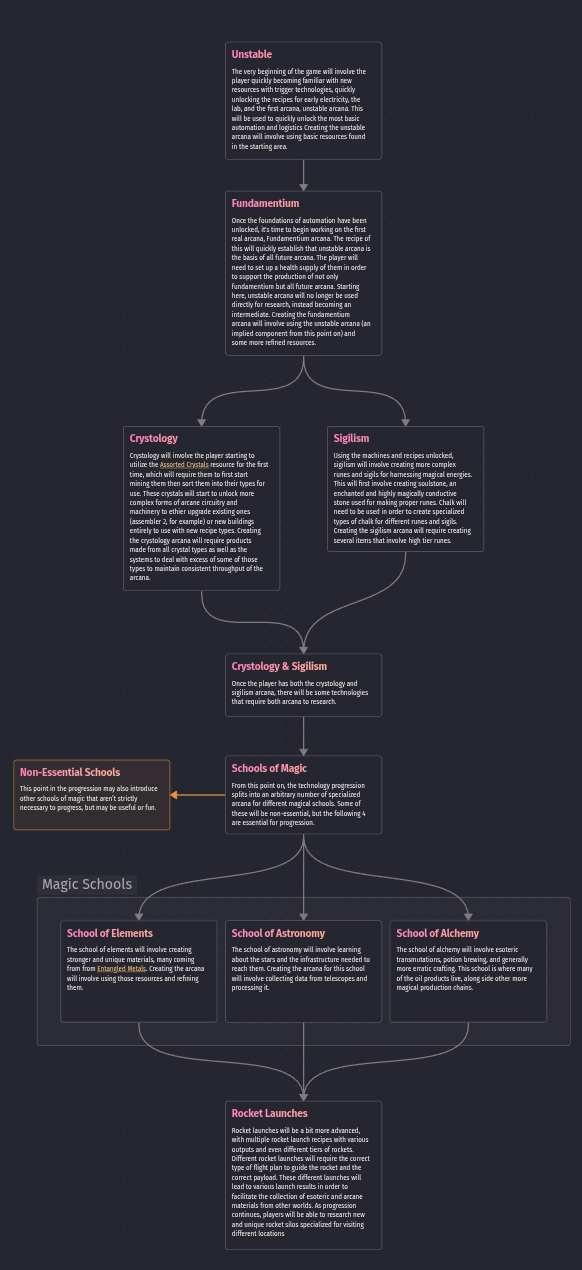
My new top-level gameplay plan
As you can see, compared to the old one, it has certainly shrunk a bit in both dimensions. Not pictured, the School of Occultism has been moved off to the side; we’ll talk about why in a little bit.
The beginning is mostly the same as it was, but with a bit more detail for guiding my decisions while designing the tech tree. The first major change is when we get to Crystology and Sigilism. I realized that having them be one after the other was somewhat arbitrary and that theoretically, with how I was picturing it, you wouldn’t necessarily need to do either first. Because of this, I figured it’d make more sense to make them parallel technology stages, allowing the player to decide which they’d like to tackle first. This also has the added effect of making the Fundamentium stage of technology a lot wider, which I think is potentially a good thing to do after having to scrape together the tools to automate things. This also means that after unlocking both arcana, there will be some technologies that require both to act as a bit of a pseudo-stage before moving on to the next part of the progression.
Now, the general idea of the schools of magic is mostly in tact, with the player needing to complete all 3 in any order (potentially with other, non-essential technology tiers introduced here as well) in order to unlock the tools and infrastructure they need to start launching rockets. The first notable difference is I’ve removed the school of occultism from this stage. The reason I decided to do this is because I’ve fundamentally changed what I want this phase of the game to be like. When I initially started to design this mod, the idea was to use the Space Age expansion as a base to have space platform based travel to space locations, some of which would be very far away, and would need special technology (from the occultism school) to both achieve FTL speeds, but to protect against some nebulous dangers I implied in the description. I’ve since changed my mind on having the mod rely on the expansion, and therefore, had to adjust this part of the mod. Now, the idea is that the player will be able to craft many different types of rocket payloads that will then “travel” to these different space locations through the normal vanilla rocket launching system, returning various products to allow new things to be crafted. Now, I do still like the idea of potentially being able to visit different surfaces, so there’s a chance that through these launches, the player will eventually be able to build portals to these places, and there could potentially be a new logistic system that involves teleporting materials between locations, but that’s nothing but a nebulous idea in my head right now. The reason I’ve set occultism aside and not deleted it, however, is because I’ve been considering the idea of having multiple “tiers” of rocket launches. Now bear with me because we’re entering very speculative and unformed ideas in my head, but the general idea is that through initial rocket launches (and possibly visiting new surfaces), the player would get new resources and materials to work with that eventually lead to better rocket payloads, which then need new technology tiers to fully utilize. Again, still a nebulous idea, but I do like the idea of expanding the vanilla rocket launching mechanic, since rockets powered magic and used to travel to magic locations is kind of the epitome of technology meets magic.
Either way, here’s an in game screenshot of the current state of the technology tree, just for fun:
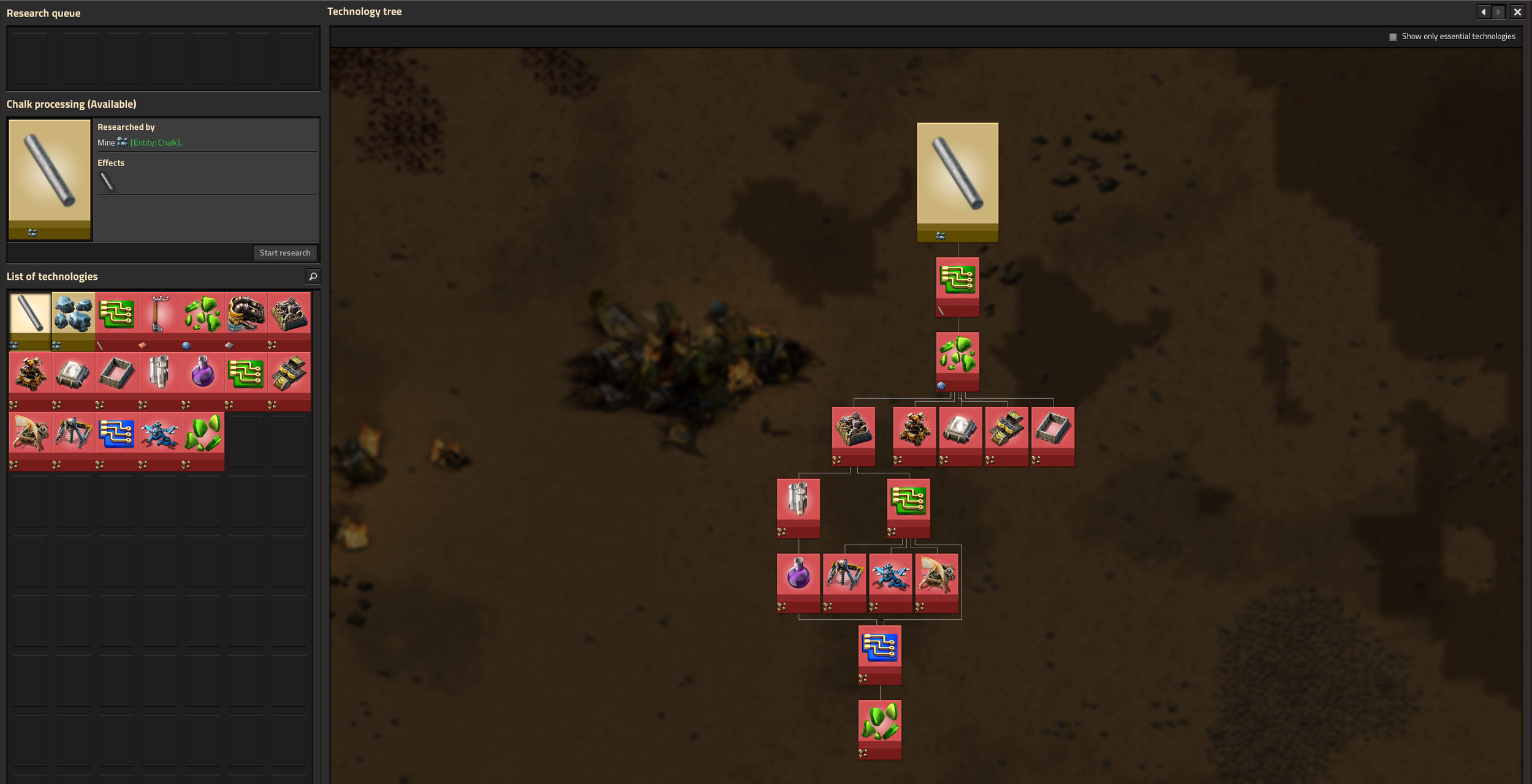
In-game screenshot of the tech tree
Most of the technology icons (and icons in general) in the mod so far are just vanilla graphics, with the exception of the couple of glassware icons in the middle row on the left side of the screen. Those come from the Quality Glassware mod, a graphics pack that I’ve made a dependency for the time being. I honestly have no idea how long it’ll take to develop this mod, but the strategies I’ve started using (as well as having a fair amount of downtime at work) have made progress fairly steady for the time being. I’m thinking about releasing a very early version of the mod after I’ve implemented up through Crystology/Sigilism to potentially start getting some feedback, but we’ll see about that as development progresses.